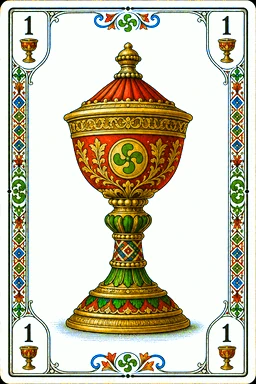
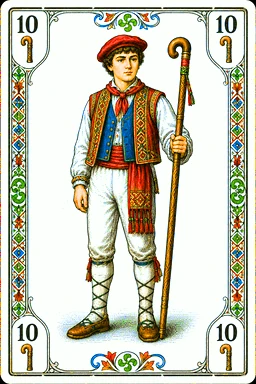
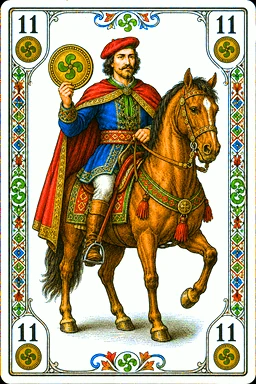
The traditional card game of the Basque Country, free and with nothing to install: take your seat at the table facing three players.
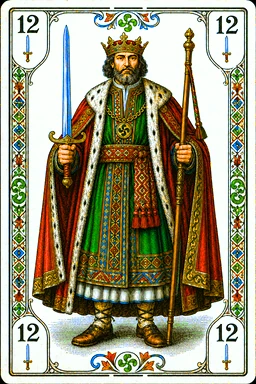
Three games to try, no sign-up
Welcome! How would you like to continue?
Born more than two centuries ago in the Basque Country, Mus is played by four, in two teams of partners sitting opposite each other, with the 40-card Spanish deck. Bluffing, discreet signs between partners and calls in Basque — Imido! Iduki! Hordago! — make it far more than a card game: an art of the table, handed down through the generations in the etxeak and village bars.
This free solo version sits you at the table facing three computer-driven players: your partner signs to you, the opponents bluff, they raise... and they will not hesitate to call Hordago! and stake the whole game on a single hand.
Mus is played by 4, in two teams of partners sitting opposite each other. Before the game you set up three opponents (name + playing style on Haundia, Tipia, Pariak and Jokoa), then choose your partner; the other two form the opposing team. First to 40 points wins. You only see your own hand. The other hands are revealed only in the end-of-hand summary, or at once if a Hordago is accepted ("Kanta").
| Card | As | 2 | 3 | 4 | 5 | 6 | 7 | Sota | Caballo | Rey |
|---|---|---|---|---|---|---|---|---|---|---|
| Haundia/Tipia | 1 (lowest) | 2 | 3 | 4 | 5 | 6 | 7 | 10 | 11 | 12 (highest) |
| Value (Jokua/Pundua) | 1 | 2 | 3 | 4 | 5 | 6 | 7 | 10 | 10 | 10 |
Important: each card has its own strict value, with no equivalences — a pair requires two cards of exactly the same rank. For Jokua/Pundua only, the Rey, Caballo and Sota are worth 10 points each.
When are the points revealed? Only a Tira is immediate for the stake — but the bonus (Pariak/Jokua/Pundua) always stays hidden until the end-of-round summary, whatever the outcome. A general Paso (everyone passes) or an Iduki defer everything (stake + bonus) together until the end.
For Haundia, Tipia and Pundua, it is the better hand of the two partners that represents the team in deciding the winner.
Ties: if both teams hold the same best hand, the Esku player wins, then the player to their right, then the next one round to the right — the player to the left of the Esku is the weakest in a tie. The game does indeed turn anticlockwise.
Who decides for your team? On Pariak/Jokua, if only your partner holds the pair or the game (or if the seating order puts them before you on Haundia/Tipia/Pundua), it is they who suggest a choice — the matching button flashes — but it is always you who click and really decide.
Pariak/Jokua call: when your turn comes you must answer "Ba" or "Ez", and the call must be truthful. Only the button matching your hand is active: "Ba" is greyed out if you do not hold the pair or the game, "Ez" is greyed out if you do. So you cannot conceal a pair or a Jokua.
Mus = I change my cards. Mintza = I keep my cards. Esku = the player who speaks first. Ba / Ez = yes / no. Paso = I pass. Imido = I bet. Iduki = I accept. Kanta = I accept a Hordago. Tira = I decline.
At most 3 rounds of Mus. A pause marks each major transition. After each hand, click "New round" to carry on.
Before each game, every AI player can be renamed and tuned with 4 sliders (Haundia, Tipia, Pariak, Jokoa) from 1 to 9. The value 5 matches the current style; below it the player is more cautious (Mus, Paso, Tira), above it more aggressive (Imido, Mintza).
In Mus, partners quietly tell each other what they hold through facial signs, unnoticed — in principle — by the opposing team.
In our game, players make their signs immediately after the deal. Watch them closely at that moment — their portrait grows noticeably larger.